
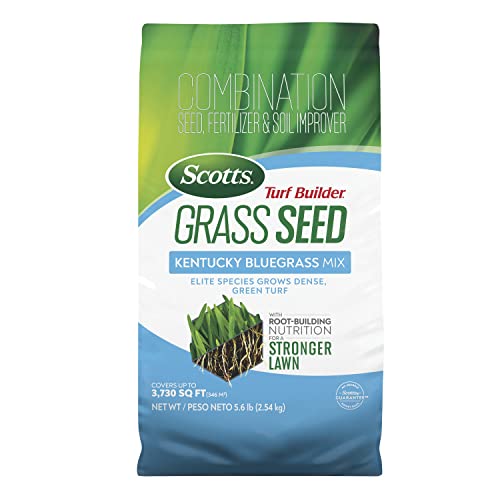
Scotts Turf Builder Grass Seed Kentucky Bluegrass Mix
Consider it for a sunny bluegrass project where eventual spreading growth matters more than the quickest first cover. Verify the bag’s cultivar analysis if variety identity is part of your specification.
- A good fit for
- Sunny, well-drained cool-season lawns where the owner wants bluegrass growth and can support a slower establishment period.
- The tradeoff
- Kentucky bluegrass is slow to establish and poorly suited to heavy shade. The current product page does not identify the exact cultivars in your retail lot.
We may earn a commission from purchases through our links. How this works
Buy on AmazonResearch-based review · Updated
Know what the 5.6-pound package contains
This is the current Root-Building Nutrition combination of Kentucky bluegrass seed, fertilizer and soil improver. Scotts lists a 4-0-0 fertilizer analysis. The purchase link selects a 5.6-pound bag, so neither the weight nor the coverage from an older seven-pound product belongs in the buying calculation.
The maker names Kentucky bluegrass as the grass species. It does not provide a current lot-specific cultivar list on the selected product page. That distinction matters when a buyer wants a particular variety: older packaging details or another retailer's seed tag should not be carried forward as proof of what is in this bag.
Use the actual analysis label to check varieties, purity, germination and test date. The combined bag weight also is not a plain-seed weight. If you compare it with an uncoated specialty bluegrass, start with each product's stated application coverage rather than assuming equal pounds will establish equal areas.[5][6][7][2]
Value spreading growth without expecting instant repair
- Why choose bluegrass
- Rhizomes help an established stand form sod and recover from injury.[4]
- Where it fits
- Open, sunny, well-drained conditions match Penn State’s species guidance.[4]
- What it will not solve
- Heavy shade, poor drainage and the need for immediate cover remain important limits.[4]
Read the bluegrass tradeoff
Kentucky bluegrass produces underground stems called rhizomes. Penn State explains that this growth gives it good sod-forming ability and recovery potential compared with many other cool-season grasses. That is a useful reason to consider the species when you want an established lawn that can thicken over time.
The same guidance identifies meaningful limits. Kentucky bluegrass does best in sunny, well-drained areas and performs poorly in heavy shade or poorly drained soil. Heat and drought can push it into dormancy. Those characteristics do not disappear because the package includes fertilizer or uses a durability claim.
A spreading grass also needs time to establish before that advantage becomes relevant. Do not buy it solely because you want a bare area to look finished immediately. For a sunny lawn with a longer planning horizon, the biological tradeoff is more coherent: slower early development in return for a species with rhizomatous growth later.[5][4]
Match 1,240 or 3,730 square feet to the job
Read the project calculation
The selected 5.6-pound manufacturer page and package artwork agree: 1,240 square feet for new lawn, or 3,730 square feet for overseeding. The large front-of-bag figure refers to thickening an existing lawn, not creating a new one on bare ground.
For a 2,000-square-foot project, dividing area by those package figures gives approximately 9.03 pounds for new lawn and 3.00 pounds for overseeding. That means one 5.6-pound bag is insufficient for the new-lawn project, while the same bag contains more than the calculated overseeding quantity. Do not empty the entire bag simply because some remains.
These calculations use the stated package coverage, including its rounded area figures. They are not pure-live-seed calculations or universal bluegrass rates. Measure the area actually being treated, then use the matching package directions and spreader settings. Different product formats can have very different bag weights for a comparable job.[5][6][7]
Allow time for emergence and keep the surface moist
The current Scotts FAQ suggests fourteen to twenty-one days to first sprouts with proper watering. Treat that as an emergence estimate, not a deadline for a complete, usable lawn. Penn State also describes bluegrass establishment as slower than most other turfgrasses.
The package recommends spring or fall planting when average soil temperature is 55–70°F, or air temperature is 60–80°F. It calls for loosening the upper two inches of soil on a new-lawn site, followed by lightly raking seed just beneath the surface. The seed itself should not be buried two inches deep.
Water daily or as needed to keep the surface moist. The package describes frequent watering for at least three weeks or until seedlings reach two inches. This is a commitment to tending the seedbed, not a fixed number of sprinkler minutes that works in every yard. Plan for the slower response before deciding that the first few quiet days require more seed.[5][6][4]
The established lawn still needs appropriate care
Bluegrass's ability to recover does not mean maintenance disappears. Penn State notes its relatively higher nitrogen requirement among cool-season grasses and its tendency to form thatch. Those are useful planning considerations, even though exact feeding and mowing practices should follow local conditions and guidance.
The species can become semi-dormant during prolonged heat or drought and recover when cooler weather and adequate moisture return. A brown summer period is therefore not, by itself, evidence that the seed failed. Conversely, a product name cannot establish how much irrigation your site will need to maintain a particular appearance.
Scotts' package identifies mefenoxam-treated seed and says it is not for food, feed or oil purposes. Keep it away from those materials and follow storage and runoff precautions. The included fertilizer should also be part of the application plan; do not compare this bag with plain seed while forgetting that you are applying more than seed.[4][5][6]
Compare Midnight when cultivar identity is the deciding factor
Outsidepride Midnight is an alternative to investigate if you specifically want a named Kentucky bluegrass cultivar. Its product directions and package sizes differ, so the Scotts coverage calculation does not carry across. Check the actual offered bag and label in either case.
A named cultivar can make research easier, but it is not an automatic reason to declare a winner. We have not tested these current retail bags side by side. Regional conditions, the seed lot and the establishment work still matter, and broad bluegrass characteristics should not be presented as a product-specific trial result.
Choose the Scotts combination when its format, verified quantity and site fit meet the project. Choose a more specific cultivar route when that identity is central to your plan. If the real problem is heavy shade or a need for immediate cover, switching between two bluegrass products does not address the main limitation.[8][2][4][5]
When to choose something else

Outsidepride Midnight Kentucky Bluegrass
Consider a named Midnight bluegrass option when cultivar identity matters; compare its own label and application rate rather than transferring Scotts coverage.
Sources & research notes
This review draws on published product information and grass-selection guidance. We have not conducted a hands-on trial of this product. Species guidance helps explain the choice; it is not a trial of the bag you buy.
- University of Minnesota Extension: renovating a lawn
Read 2026-09-23
- UMass Extension: understanding the turfgrass seed label
Read 2026-09-23
- Pennington: The Rebels Tall Fescue Grass Seed Blend
Read 2026-09-23
- Penn State Extension: turfgrass species for Pennsylvania, bluegrass and fescues
Read 2026-09-23
- Scotts: current product description and package-specific directions
Read 2026-09-23
- Scotts manufacturer package artwork and use directions
Read 2026-09-23
Amazon product identity: Scotts Turf Builder Grass Seed Kentucky Bluegrass Mix, 5.6 lbs.
Commerce identity only; not evidence of product performance.
Buy on AmazonRead 2026-09-23
- Outsidepride: Midnight Kentucky Bluegrass planting guide
Read 2026-09-23
Ready to compare the bag?
Check the package size and seed tag before ordering.